
Social Emotional Learning (SEL) is the latest attempt by the educational establishment for “character education” to regulate behavior by teaching “skills” that will translate into positive relationships and behaviors. Some will recall the unrealized promises made by previous attempts in “values clarification”, the self-esteem movement, “Just Say No” campaigns, anti-bullying programs, etc.
According to the Virginia Department of Education and Collaborative for Academic, Social, and Emotional Learning (CASEL):
SEL is the process through which all young people and adults acquire and apply the knowledge, skills, and attitudes to develop healthy identities, manage emotions and achieve personal and collective goals, feel and show empathy for others, establish and maintain supportive relationships, and make responsible and caring decisions.
Virginia Department of Education SEL Guidance Standards
That sounds laudable.
What parent does not want their children to accomplish all of those goals? But,
- What “knowledge, skills, and attitudes” in this “process” are going to lead to those achievements?
- Who decides the “knowledge, skills, and attitudes” that will be taught?
- How, exactly, will knowledge, skills and attitudes develop
- healthy identities,
- manage emotions,
- achieve personal and collective goals,
- feel and show empathy for others,
- establish and maintain supportive relationships,
- and make responsible and caring decisions?
FCPS and other proponents of SEL do not give specifics or details. It is very difficult to pin down these nebulous curricula. We are just told, it is working! Based on what? The reports that FCPS students are required to make semiannually?
If the purpose of SEL is to promote Virtue, Why can’t they use the term “Virtue”?
The described goals sound like they are promoting virtuous living. But because the Curricula are wedded to a “secular” approach, they cannot ever refer to “Virtue”. Even Aristotle, a pre-Christian, could define Virtue. Instead, the curricula talk in terms of “competencies”. Has anyone ever defined good relationships as “competent”? Virtue and relationships can be taught and modeled, but only if an institution (i.e. the family) is able and willing to state clearly what virtue means. Moral relativism is required by the schools that insist on being removed from Religious (particularly Christian) influence. However, by no means is SEL value-free.
Max Eden, a fellow at the American Enterprise Institute and his colleagues have taken a deep dive into Social Emotional Learning. Social Emotional Learning has always been problematic from a Christian perspective because it promotes what Dr. Paul Vitz, Senior Scholar at Divine Mercy University in Sterling, Virginia and emeritus professor of psychology at New York University, calls Psychology as Religion: The Cult of Self Worship. But Eden explains that in 2010 a revolutionary change took place to incorporate Critical Race Theory (CRT) into what is now called “Transformative SEL”.
That prism (race, class, gender, ethnicity, sexuality, and disability interact to create overlapping and interdependent systems of advantage and/or disadvantage for students) has, as the authors note, increasingly become a core feature of the SEL enterprise ever since 2019 when, with the Jagers et al paper cited, the Collaborative for Academic Social and Emotional Learning (CASEL) embraced what it calls “Transformative SEL.” As I’ve detailed in several other pieces, Transformative SEL takes the previously morally neutral core competencies and infuses them with CRT-derived values.
Max Eden, Does Social and Emotional Learning Work? Let’s Hope Not
Q: Shouldn’t kids learn many of these skills at home?
Karen Cairone, Why Does Social Emotional Learning Matter?
Cairone: Absolutely. But if you have a family that is struggling to meet basic needs—whether economic or emotional—then the parents may not be focusing too much on things like sharing and being patient at home. So it’s important for the school to teach those skills. This work is not undone when children leave the classroom; it actually gives children more skills to use at home. And in best case scenarios, you have families reinforcing and teaching these important social and emotional skills in the home environment as well.
If this sounds upside down to you, that is because it is!
Parents are the primary educators of their children, particularly when it comes to faith and morals, i.e. “family life”. The preceeding quote by SEL Advocate Karen Cairone underscores the educational establishment’s view of parents — absent, distracted, incompetent, negligent. The schools must educate our children and hope we don’t mess up what they taught when the children get home.
Let’s look at a few examples of how SEL is indoctrinating children with an ideological agenda and/or undermining the authority of parents.
Board Changes Definition of “Two-Parent Family” To Reflect LGBTQIA+ Agenda
456. What is the nature of the family in the plan of God?
THE FAMILY IN GOD’S PLAN, CATECHISM OF THE CATHOLIC CHURCH
A man a woman united in marriage form a family together with their children. God instituted the family and endowed it with its fundamental constitution. Marriage and the family are ordered to the good of the spouses and to the procreation and education of children. Members of the same family establish among themselves personal relationships and primary responsibilities. In Christ the family becomes the domestic church because it is a community of faith, of hope, and of charity.
Since “God instituted the family and endowed it with its fundamental constitution” only God has the Authority to change the institution of the family. “Members of the same family establish among themselves personal relationships and primary responsibilities.” It is not the place of the school to usurp God’s or the family’s authority in this manner.
But, on June 17, 2021 at the end of a tumultuous year where kids were denied in-person education because of Fairfax County Schools inability to provide a “safe environment”, the School Board took up the recommendations of the Family Life Education Committee Curriculum Advisory Board (members of FLECAC are appointed by FCPS Administration and School Board members). FLECAC recommended minimal changes to bring the objectives into line with Virginia State requirements. FLECAC has accomplished a radical agenda in the previous decades, and so there is little left to tweak. FLE Objectives and Human Growth and Development Objectives provide general topic areas, but FCPS has been consistently moving controversial topics into subjects that do not allow parental oversight or opt outs, such as English, Social Studies and Science.
Board Member Karl Frisch felt it necessary to amend the Kindergarten and First Grade SEL curriculum to clarify the description of the two-parent family traditionally understood as “a mother and a father” to include “two mothers, two fathers”, as if the reason for the distinction of “two-parent” is quantitative, rather than qualitative.
Does FCPS give a Definition of Family, or do they annihilate the Definition of Family? Is that a legitimate role for Schools or usurpation of the authority of the family?
Even without this blatant move for indoctrination of our youngest children, (who developmentally cannot understand or process the needs of LGBTQ+ advocates), does any parent believe they need the school to teach their children that there are different types of family? To what end? Is there any legitimate educational reason for this lesson? If each family defines its membership, why is the school inserting itself into that discussion? Do parents want their children subjected to questions violating the privacy of family life? Are all types of family equal? Is there any effort to provide the abundant data that shows the outcomes for children of parents raised by a mother and a father (not two parents) exceed the outcomes for children in non-traditional families. The schools have succeeded over the decades to decrease the number of children raised by a mother and father in favor of the alternative family structures FLECAC and others have been promoting. The Two-Parent Privilege: How Americans Stopped Getting Married and Started Falling Behind
Is this just an exercise in moral relativism to undermine any sense of societal norms? Or is it also a means to allow the teachers who brag on TikTok that they are indoctrinating children and discussing their own sexual lives with children? It is necessary to state that the many teachers (perhaps the majority) in Fairfax Schools have our children’s best interest in mind and resist whenever and wherever possible to protect the innocence of children from the assaults promulgated from the Administrative Offices and the Board. Some teachers however, have been indoctrinated by professional development “embedding an equity focus” in everything FCPS does.
Let’s Look Directly at FCPS Board Actions and Lesson Plans

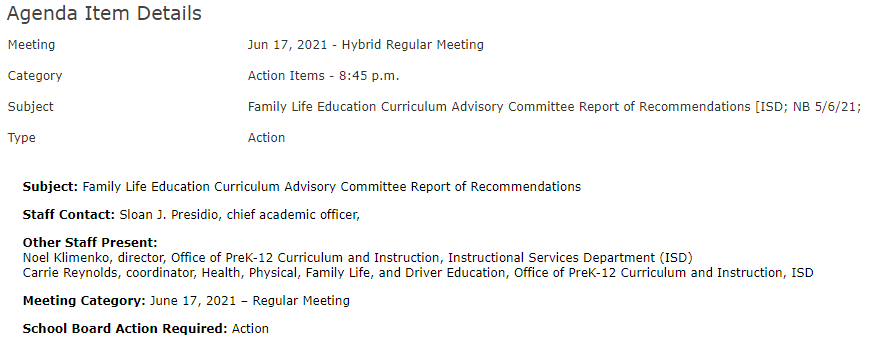
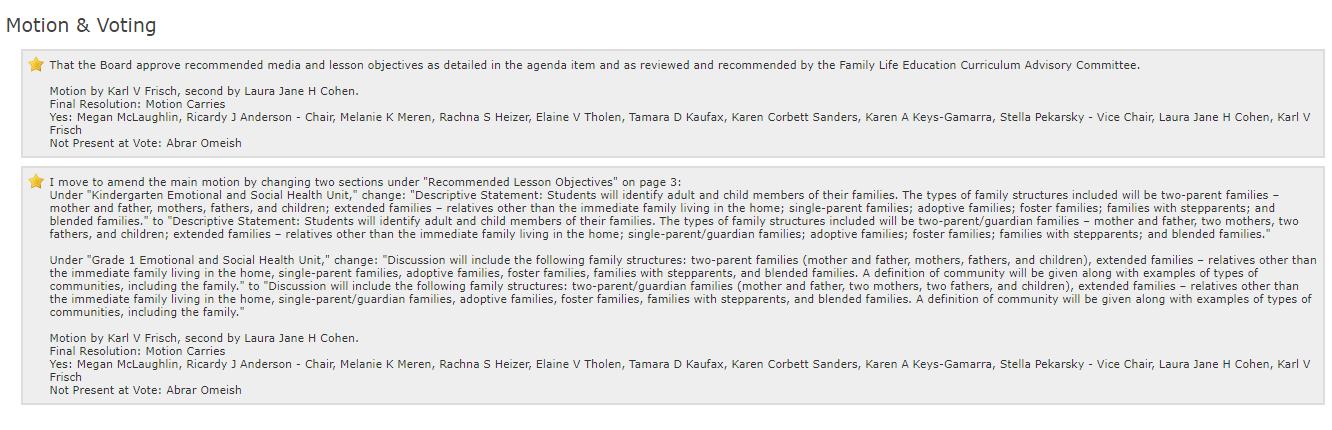
While the Family Life Education Curriculum Advisory Committee did not make any such recommendation. The parents and community were not consulted. The Fairfax County School Board voted to redefine the family to include “2 mothers” or “2 fathers” and to educate your children beginning in kindergarten with that “knowledge and attitude” as required by SEL. What will be next? On his re-election website, Karl Frisch states that he and his partner Evan “are the proud dog dads of Dexter, an energetic twelve-year-old Wheaten Terrier mix.” Will there be a need for Mr. Frisch to “clarify” the definition of “child” to include “dogs” to reflect his stated “parenthood”?
What does this change look like in the classroom?
FCPS Family Life Education 1st Grade Lesson 1 – My Family Community


What can the rationale for the above exercise in a classroom setting possibly be? Many children suffer from “parent loss”, either from divorce or death, or never knowing a parent because of single-parenthood. Other children at age 6 are still struggling with separation anxiety at being away from family in school. What is a teacher to do with all those “feelings” that are encouraged to rise to the surface because of this exercise of “meditating” on their family situation? What about the children who will hear for the first time that some kids have two parents? At age 6, children are concrete thinkers and their understanding of justice is still at the level of equity (everyone gets the same thing). How come other kids get two mothers and I only get one? Is this exercise child oriented or does it appease the indoctrination desires of ideologues?
Undermining Children’s Sense of Security by Defining “Feeling Safe” as a “Social Emotional Need” and Putting Responsibility of “Safe Environment” on the Child
The greatest potential harm of SEL and previous attempts is the inverting of adult responsibilities and children. In the 1980s, prevention programs flipped from a “safe environment” where adults were alerted to problems and given strategies to protect children to moving them into the classroom and expecting children to resist and reverse social problems that were creeping into the culture. When your child enters school, while perhaps hesitant, he enters feeling secure in the knowledge that his parents are and will protect him. For the next 12 years he is bombarded with lessons of all the dangers that await him.
Creating a Mental Health Crisis?
Whenever, a new “problem” issue is identified (often by consultants selling an expensive “responsive” curriculum), all students are educated as if they are all susceptible to harm and there is an increase in the problem behavior (cutting, bullying, suicide, transgenderism, lgbtq+ identification, pregnancy, sexually transmitted infections, drug abuse) as children are susceptible to social contagions because of their strong need to “fit in” as they struggle to define their own sense of identity. Counselors can often identify what is being emphasized in school, by the problems that teenagers present in therapy. There has been a decrease in teen pregnancy in recent years as there has been a decrease in its emphasis in FLE classes that have moved toward LGBTQ+ topics. Is that coincidence or correlation? At the same time the number of children reporting LGBTQ+ identification has sky-rocketed.
This bombardment of “dangers” has led to a crisis of anxiety and depression among children of all ages. Accompanying the lessons on dangers (abuse, climate change, racial inequalities, group oppression, unmet social emotional needs, suicide, pornography, trafficking) is a premature discussion of anxiety and depression.
Every person in daily living can claim one or more of the “symptoms” in the diagnostic criteria of each condition. To make a successful diagnosis, a professional must have an objective view of a patient’s history, current life situation and triggering events, intensity and duration of symptoms, etc. Though FLE/SEL children are shown videos of peers experiencing various conditions and told to create scenarios to show an understanding of the particular condition. These exercises lead to amateur self-diagnosis and self-fulfilling prophecies. How many doctors (and parents of teens) tell patients to stay off WebMD?
One of the expressed goals of SEL is to “reduce the stigma of mental health problems”. Each student is told that they are likely candidates of “anxiety” and “depression” because it happens to everyone. To solidify this point, course materials require using images from all identified “groups.” This not only happens in mental health issues, but physical maladies that they are taught with children having irrational fears of contracting diseases for which they have little risk. What if instead, schools and parents advised children follow the Golden Rule and follow the timeless advice of the Saints?
SEL curricula acknowledges the impact of “peer-pressure” on middle school and high school students because of the developmental need to “test” norms by comparing yourself to others around you. But as social contagions arise in middle and high schools, usually surrounding SEL topics (‘gender expansive identities”, suicide, etc.), there seems to be cognitive dissonance on the part of those involved.
The major influence causing social contagions are likely the “Social Influencers” on TikTok, Instragram, Facebook, etc. But these influencers are tapping into topics given credibility in SEL classes by trusted adult “authorities.” In addition, the clear messaging in SEL is to “speak up”, “tell your truth”, “be the change”, — be an influencer!
Christopher Rufo, of the Manhattan Institute has done a deep dive into the roots of CRT and SEL. He created a powerful new video highlighting the connections between pervasive mental health problems observed today and the messaging of the educational programs: The Cluster B Society How psychological dysfunction has been embedded in our institutions.
Children warned that Family Members May Abuse Them
The next lesson for these precious children is “Good Touch, Bad Touch” (which will continue in every grade throughout their FCPS career) where they are alerted that they may be abused by family members.
Critical Race Theory
[In 2019] the Collaborative for Academic Social and Emotional Learning (CASEL) embraced what it calls “Transformative SEL.” As I’ve detailed in several other pieces, Transformative SEL takes the previously morally neutral core competencies and infuses them with CRT-derived values.
This is especially noteworthy, given that – as the authors point out, SEL in practice is essentially an inherently ideological enterprise: “Activities that focus on values were endorsed in 220 studies (49.5%), activities that focus on perspectives were endorsed in 125 studies (30.2%), and identity instruction was endorsed in 145 studies (34.1%).” (Emphases in original.)
Whose values? What perspectives? Who defines “identity”?
Does Social and Emotional Learning Work? Let’s Hope Not By Max Eden
 parentsoutofexile