
“God trusted you with that child, trust yourself!”
A parent’s greatest fear is harm to a child. For decades the schools have been teaching “good touch, bad touch” to “protect” children from predators. Parents assume the programs are effective and beneficial with no harm. Lacking the confidence to adequately address the topic and protect their children, parents turn it over to the “experts”.
Consider your young child and his/her intellectual and emotional capacities, needs, experiences, vulnerabilities, and cheerful, secure sense of being. Keep this in mind as you reflect on the realities and appropriateness of school-based child sexual abuse prevention programs.
For those who want to dig deeper into these so-called “child sexual abuse prevention programs”, With the Best of Intentions: The Child Abuse Prevention Movement, by Jill Duerr Berrick and Neil Gilbert (UC Berkeley School of Social Welfare) gives a history of how these programs shifted the burden of responsibility for protecting children from adults to young children. This approach is considerably different than Child Protection Programs (such as the VIRTUS Program used by the Diocese of Arlington) that focus on community education, adult interventions, and parental responsibility.
No Evidence that Good Touch, Bad Touch Programs Accomplish What they Claim
The assertion of proponents that the programs would inoculate children from sexual abuse by teaching children to recognize and avoid abuse has not been demonstrated. The premise assumes that children 4-10 years of age have the capacity to understand sexual abuse, particularly when it is presented in vague terms such as “uncomfortable feelings and “inappropriate touch” and can “protect themselves” from a person who can outplay them physically, emotionally and psychologically.
Why would Fairfax County Teach a class to young children when there is a need to issue this warning every year in every grade?


Suggested Note from Parent to Teacher/Counselor: You have no right and do not have my consent to teach my child any “sensitive topic” that you know may make them feel uncomfortable and may require counseling or additional support.
HMMM. Why Are Our Kids Exhibiting So Much Anxiety?
The introduction of sexual abuse as a probability, including by persons in the child’s family, violates the innocence, security and tranquility of childhood. When parents raise the topic of sexual abuse with young children, they are doing so because of a particular need by a particular child. Parents understand each child’s temperament, experience and cognitive abilities. Parents can provide solace to children by reading the child’s response to the information. Some parents may never raise the issue with a particular child because of the special sensitivities of that child. Children presented with this information in a group setting by a teacher who has limited interaction with the child, or worse, an outside “expert” counselor who has had no interaction with the child previously, are placed at greater risk that the information can be traumatic. Most children will not give verbal responses to information provided. They do not not have the capacity to articulate their responses. Young children are prisoners of logic. Without individual communication to understand how the information is processed and interpreted, the teacher has no way of knowing whether the child has received the information appropriately, or understood it in a logical, but disordered way.
The topics covered in these lessons elicit discomfort from children because they violate the child’s innocence and tranquility. There is institutional bias in the schools that the school must protect children from their parents. A child who shows discomfort in a lesson on child sexual abuse will be interrogated by the school counselors because it indicates “reporting may increase, or additional support may be needed”. In other words, the presumption will be that the discomfort is caused by a child being sexually abused, possibly by a parent, rather than spiritually assaulted by a well-meaning teacher. Therefore, initial discussions with your child following his/her discomfort will not likely include you or even be known by you as a parent.
The Catholic Church warns about the danger of
attempts to impose premature sex information on children… Such information tends to shatter their emotional and educational development and to disturb the natural serenity of this period of life. Parents should politely but firmly exclude any attempts to violate children’s innocence because such attempts compromise the spiritual, moral and emotional development of growing persons who have a right to their innocence.”
Pontifical Council of the Family, The Truth and Meaning of Human Sexuality
Kindergarten
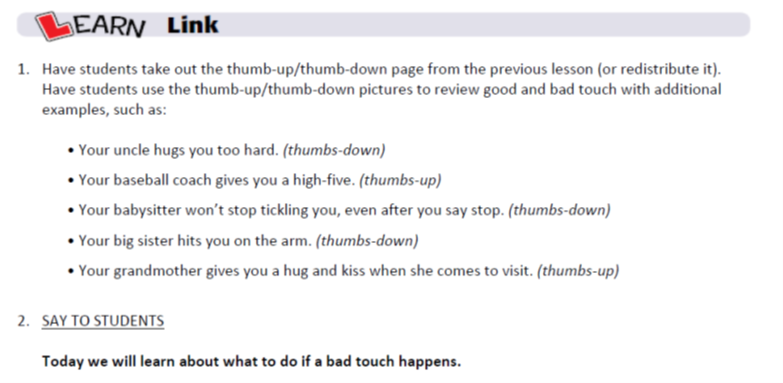
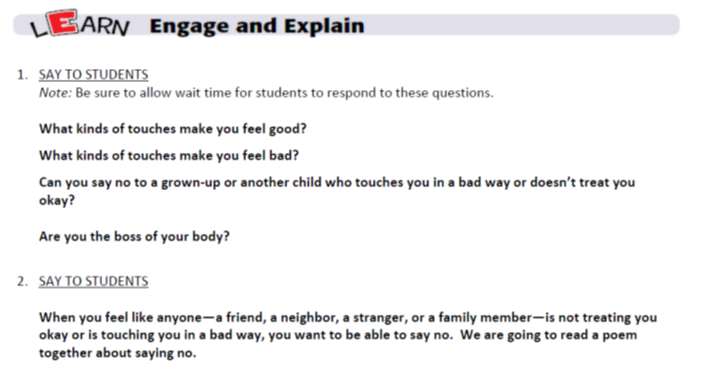
Your precious 5-year-old is expected to make sense of vague descriptions and messages of good vs. bad without context or understanding of the relationships or persons involved in the interactions. This is the first contact, in an annual campaign to set the stage for the school’s “warning” children about how they may be hurt at home and by other trusted adults.

1st Grade
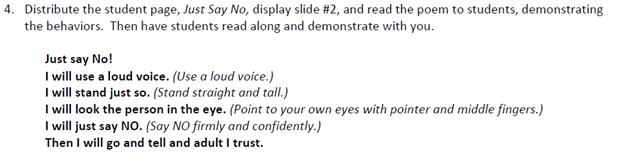
This lesson tells your 6-year-old they will be getting “inappropriate” messages on their cell phones and computers.

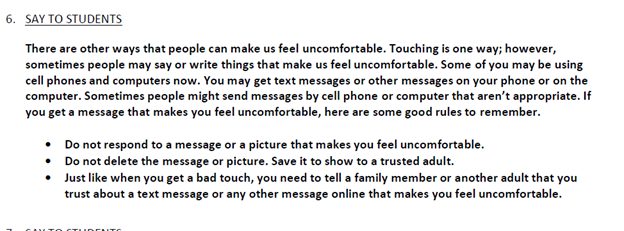
And the confusing vagueness of what is and isn’t a good touch continues:
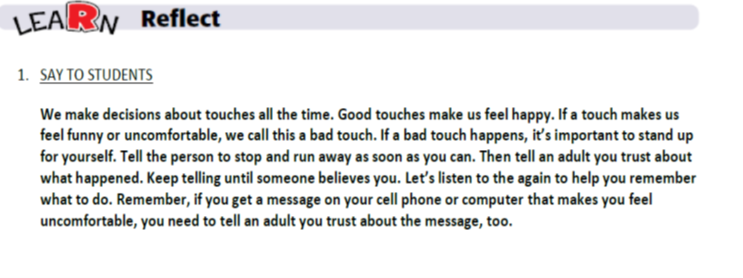
2nd Grade
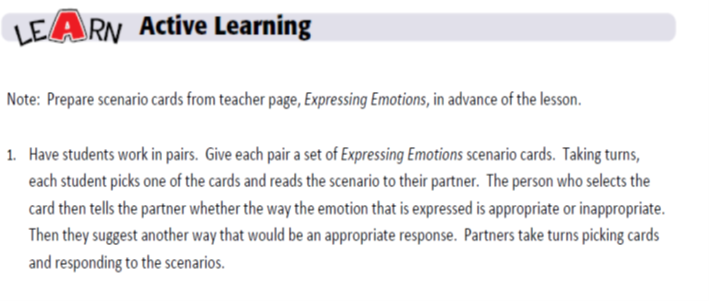
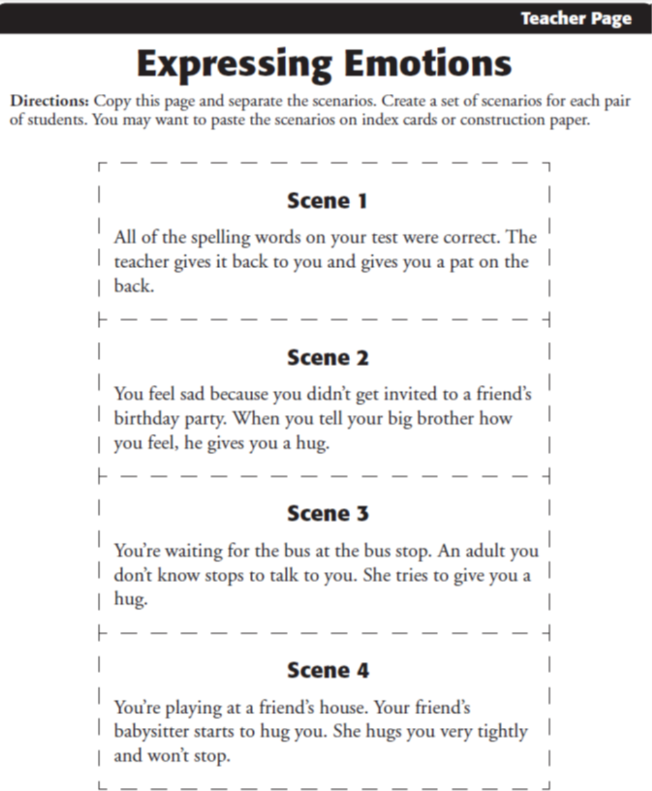
Children are presented with scenarios which may or may not happen, yet raise their anxiety about what may or may not be innocuous behavior of strangers and family members:

3rd Grade
When they are 8-years-old, your children will be shown an explicit video You are in Charge of Your Body. Part 1: Recognizing Sexual Abuse depicting situations that may include child sexual abuse. How likely are these scenarios and is there a better way to protect a child than to make every Dad or older sibling a bogeyman? As for the mother’s boyfriend, children of single parents are more at risk of abuse by a sexual partner of the parent than children in a mother/father (biological or adoptive) family data. Yet, the other theme of Family Life Education in Grades 1-4 is to undermine the permanence of parent/child relationships and expand the definition of family to include individuals who may put children at risk. The term “incest” is introduced in third grade.


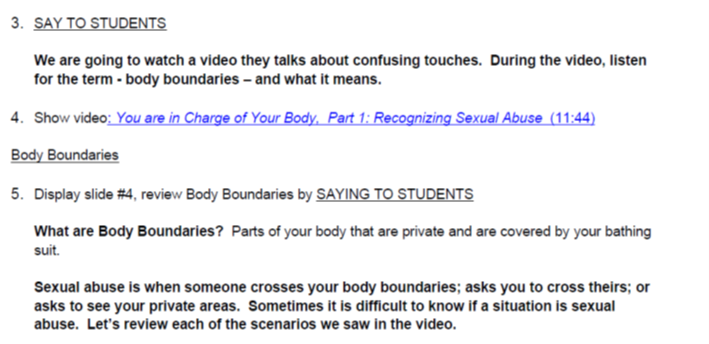
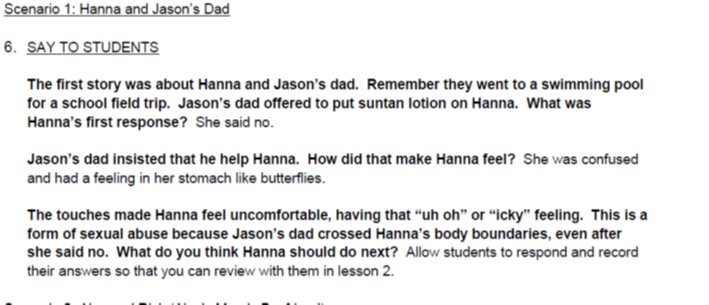
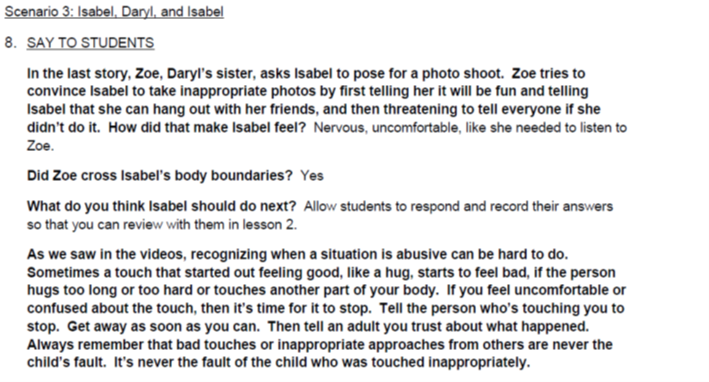
Ideology Behind Child Abuse Prevention Programs
Children’s rights and body ownership are key components to all prevention programs. Children are taught chants and rhymes that underscore that they are in charge of their own bodies and no one has control over them. This has led to the phenomenon that many adults observe of children today “being afraid of everyone and no one.”
Traditionally the themes of the programs have been:
- a touch continuum explaining acceptable touch and non-acceptable touch
- secrets and strangers
- reporting abuse
- feelings
- everyone is a potential abuser, including parents and other family members (Berrick)
Analysis of the program contents and the developmental needs of children showed that the programs are not achieving the goals intended because the philosophy and content are not consistent with the needs of children. Jill Duerr Berrick and Neil Gilbert of the School of Social Welfare, University of California, Berkeley and a team of researchers did an exhaustive three-year study of child abuse prevention programs, from origin, to content analysis to a comparison of program objectives and child developmental needs to a review of the outcome evaluations of the individual programs. Any serious student of this topic should read their book, “With the Best of Intentions: The Child Abuse Prevention Movement”. A content analysis of 41 sexual abuse prevention programs across the country found that:
- 61% identified empowerment as the guiding conceptual framework
- 2% were guided by developmental theory
- 2% were guided by learning theory
- The remainder could not be identified with any particular framework, but
- 86% of programs for pre-adolescent children mentioned “body ownership” and taught assertiveness training skills, the basic elements of the empowerment model. (Berrick, p.31)
The researchers concluded that:
“Prevention curricula appears to be shaped more by the ideology of empowerment than by any other considerations. Program providers claim that developmental factors weighed heavily in the design of prevention curricula; yet in a detailed content analysis of the major curricula available to preschoolers, first graders, and third graders, program similarities stand out more clearly than do differences. The primary differences in programs for younger children can be found in the methods of curriculum presentation. In this respect, providers are well attuned to the attention span of young children and their needs for varied activities. Appropriate methods and length of presentation, however, are no substitute for content tailored to children’s abilities. Without careful regard for the cognitive limitations and the moral behavior of young insert page on child development children, the effectiveness of prevention curricula is compromised.” (emphasis added) (Berrick, pp. 42, 45)
If These Programs Are Not Effective, Why Are They Promoted?
School districts across the country have been providing this approach for decades, convincing parents they must be okay. Child sexual abuse prevention/sex education/social emotional learning is a big money business with effective lobbying.
In 1987, the California Office of Child Abuse Prevention Programs expressed concerns about the preschool sexual abuse prevention program from negative reports of program effectiveness. The child sexual abuse prevention activists enlisted Assemblywoman Maxine Waters, who had authored the original funding bill. Waters threatened to decimate the budget of the Department of Social Services if changes were made to the preschool program and the Office of Child Abuse Prevention Programs was ordered to reinstate preschool programs and to form a blue-ribbon task force to examine the issue. The task force consisting of 14 people from the fields of child development, law enforcement, education, research, and prevention programs issued a report in 1989 and their findings did not support Waters and the advocates of school-based sexual abuse prevention programs. The Task Force observed:
Parents and teachers are the most important influences in a preschool child’s life, and primary prevention programs are in a unique position to reach both groups with vital information about how to prevent child abuse… Protecting young children is an adult responsibility; certainly, we cannot expect preschoolers to shoulder the burden of protecting themselves. The Task Force believes, therefore, that the central focus of primary prevention during the preschool years should be on the training and education of parents and teachers. (Berrick, p. 28)
The Task Force listed the concepts that should not be taught to preschool children.
This list of prohibitions essentially gutted the program as they were the core concepts. But the programs were allowed to continue because of political support. (Berrick, p. 28) It should be remembered that this Task Force only looked at pre-school education. Since many of the same problems apply to children in younger grades, it is likely that the same recommendations would be made for older children if a Task Force examined it. Following are the concepts that the Task Force deemed inappropriate:
What Children Should Not Be Taught
- the abstract concept of “body ownership” (“your body is your private property”)
- touch experiences classified into categories such as “safe” and “unsafe”, or “good”, “bad”, and “confusing”;
- presentation of specific acts of private-parts touching by demonstration or use of media;
- presentations about adults or older children harming them physically or sexually;
- teaching physical self-defense skills to preschoolers;
- teaching children to “get away” or “run away” from an abuser or abusive situation, which creates unrealistic expectations about their abilities to outrun or ward off adults;
- teaching preschoolers about the concept of secrets (for which they have an immature understanding) in the context of child abuse prevention;
- teaching preschoolers to “trust their feelings” as a way to avoid abusive situations;
- emphasizing rules for preschoolers in the context of child abuse;
- teaching children “don’t talk to strangers” which creates distrust and cuts children off from potential sources of help;
- teaching preschoolers about fault and blame;
- teaching assertiveness skills in the context of warding off abuse;
- the concept of “children’s rights” (which they could understand only as the opposite of “left” or “wrong”). (Berrick, pp. 28-29)
Conclusion
The child sexual abuse prevention programs that sprung up in the 1980s and are used by FCPS do not accomplish what their supporters claim but come with risk to many children.
While the messages in the programs have not been shown to have any impact on child sexual abuse, they will likely shape their attitudes and philosophies, causing conflict with the values that they are learning in their families. “You Are in Charge of Your Body!”
The lack of data supporting the claims of promoters has not dampened the enthusiasm of supporters, including parents. However, research indicates that few parents, including avid supporters, are familiar with the content of the programs or have seen any positive results. Instead, it appears the child abuse prevention movement has been successful at tapping into the fears of parents and community leaders who are looking for an inoculation against child sexual abuse. There is no question that presenters of this program are well intentioned and are passionate in their quest to rid the world of child abuse. They are equally sincere in their belief that their programs are effective.
The road to hell is paved with good intentions.
St. Bernard of Clairvaux
Parents Must Reclaim the Authority Given Them by God
It is not enough for the schools to have laudable intentions or have a history of providing education, without transparency of data showing effectiveness.
In contrast to classroom program effectiveness, follow-up studies found that parents are doing their job in “warning” their children about potential abuse. Parents have a high degree of confidence that their children are prepared. (Berrick pp. 86-87)
Therefore, the Catholic principle of subsidiarity requires that the schools respect that this responsibility stay with the family. Subsidiarity only allows outside institutions to step in when family cannot handle the responsibilities of parenting – when help is needed. There is no evidence that parents cannot fulfill this responsibility. Schools have no authority unless it is ceded by parents.
Parents are the most appropriate persons to discuss sensitive matters of child safety with children when it is needed.
Having given and welcomed life in an atmosphere of love, parents are rich in an educative potential which no one else possesses. In a unique way they know their own children; they know them in their unrepeatable identity and by experience they possess the secrets and the resources of true love.”
The Truth and Meaning of Human Sexuality
It can never be anticipated how a child will react or interpret any bit of information and it is incumbent for any adult sharing sensitive information on sexual abuse to be individually focused on the child’s response.
Classroom situations, because they cannot address the child individually, can lead to confusion and heightened anxiety. Parents must be encouraged in their parenting role to provide proper supervision to their children including knowing and monitoring all their relationships. Parents should trust their instincts and investigate any incidents or relationships that make them uncomfortable. Parents can be alerted to signs of sexual abuse, such as changes in mood, depression, withdrawal, secrecy, etc. with the caveat that they do not necessarily mean sexual abuse but raise enough concern that there is a problem of some type that must be addressed.
People of goodwill must actively challenge the institutions: media, schools, government, community organizations, therapists, etc. that promote or allow a distortion of human sexuality and family life.
Introduction of Radical Gender Theory Assaults the Innocence of Children
The introduction of Radical Gender Theory in the schools has created new and never imagined problems for children. For example, once your child is in 5th Grade in Fairfax County your child can decide which “puberty” lesson to go to – male or female. You may or may not be told:
5th Grade Human Growth and Development Puberty (Lesson Plan identical for boys and girls) but taught separately. (This may change. There is an effort to combine boys and girls for this class that has historically been recognized as too sensitive to combine the sexes. ‘Majority doesn’t always dictate:’ School board ignores 84% of parents on how to teach sex-ed and the inclusion of ‘gender identity’)
For teachers:
The following lesson is intended for students whose sex assigned at birth is male. There is also a lesson for students whose sex assigned at birth is female in this unit. Students may choose which lesson they participate in based on their gender identity. Teachers and counselors are encouraged to work with students and their support team to decide which lesson is best suited for them. Please remember to respect names and pronouns of students in your class.
5th Grade Human Growth and Development Puberty Lesson
This raises many questions, including:
- Do the “educators” realize that it is your body, not your “identity” that goes through puberty and even if a boy identifies as a girl, he cannot go through the puberty of a girl?
- What qualifies these “experts”? Should parents cede their authority to these “experts”?
- Who is the student’s “support team”?
- Are parents aware that their student has a “support team”?
- Is there a correlation between an increase in pre-teens requesting puberty blockers and the annual repetition of a lesson (beginning in 4th grade) that causes children discomfort.
 parentsoutofexile