
Here is a “gold-standard” discussion of SEL’s approach to “Ethical Decision-Making and Social Responsibility” from Greater Good in Education (UC Berkeley). Can you identify the critical piece that is missing and why this approach will ultimately cause more harm than good for individual students and society in general?
In a secular environment, “decision-making” can only be taught using “skills” for “practical” decisions. Moral absolutes can play no role. For many decisions in life, that is okay. Do you want pizza or salad for dinner? (There may be some practical nutritional issues to consider, and it may even be argued that they could have a moral component if the health of the person is at issue, but it usually isn’t an “ethical” decision.)
In other situations, the decision should be evident before a process is started because the considered behavior is immoral, including the scenarios students are given. The scenarios are proposed as if there are different outcomes that could be ethically valid. The Ten Commandments would argue otherwise. If the “means” (behavior) OR the “end” outcome are immoral — THERE IS NO NEED FOR A “PROCESS” OR “SKILLS”.
In surveys to students about particular behaviors, the instructions inform students (there are no right and wrong answers) because they are just looking for truthful responses. The exercise itself presents a near occasion of sin by suggesting there is no judgment to the behaviors (only accurate reporting is important). In lessons on pornography and sexual activity, the focus is on “consent”. Obviously, consent is an important value, but the underlying behavior may be a non-starter with or without consent because of its moral hazard.
Michael Pakaluk addresses the question “Can Ethics be taught?” in an article in The Catholic Thing. He makes the interesting observation that:
All the courses on ethics in universities of Christian foundation (“methods of ethics,” “types of ethical theory”) arose after those institutions became secularized. (emphasis added)
Michael Pakaluk, Can Ethics Be Taught?

Greater Good in Education is produced by UC Berkeley’s Greater Good Science Center (GGSC). The GGSC studies the psychology, sociology, and neuroscience of well-being and teaches skills that foster a thriving, resilient, and compassionate society–what we call “the science of a meaningful life.”
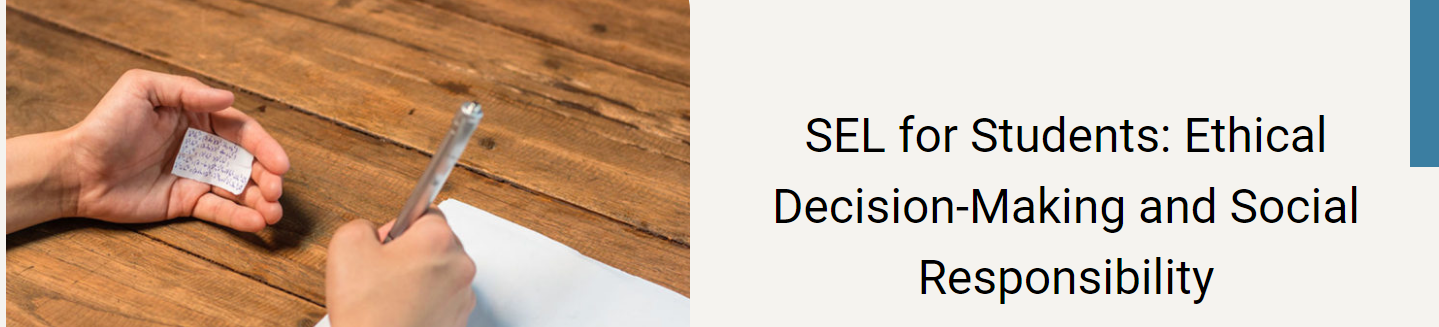
According to the Collaborative for Academic, Social, and Emotional, Learning (CASEL), social-emotional learning (SEL) is “the process through which all young people and adults acquire and apply the knowledge, skills, and attitudes to develop healthy identities, manage emotions and achieve personal and collective goals, feel and show empathy for others, establish and maintain positive relationships, and make responsible and caring decisions.”
Responsible decision-making is one of the five components that make up CASEL’s model of SEL. It means the ability to make caring and constructive choices about how to behave, based on consideration of ethical standards (i.e., “benefits and consequences for personal, social, and collective well-being”) as well as relevant social norms and safety concerns.
Here, we use the term ethical decision-making and responsibility for this component in order to emphasize the ethical dimensions of what it means to make decisions that are both personally and socially responsible. From small, everyday choices to larger and more consequential ones, students face a myriad of decisions with ethical implications. How do they decide to do the right thing, or even what “the right thing” is?
FOR EXAMPLE:
A student’s best friend has been having trouble in math class and asks her if she would be willing to help him on a take-home assignment. Their teacher clearly specified that this assignment was to be done individually.
FOR EXAMPLE:
A student witnesses some of his classmates teasing a new classmate who recently arrived from another country. They mock his accent and make fun of how he dresses. The student who sees this feels uncomfortable, but everyone else seems to be laughing along. He worries that if he intervenes, he will become a target himself.
Skills involved in ethical decision-making and responsibility include:
- Demonstrating curiosity and open-mindedness
- Learning how to make a reasoned judgment after analyzing information, data, and facts
- Making ethical decisions based upon mutual respect and appropriate culturally-relevant social norms
- Recognizing one’s responsibility to behave ethically
- Identifying solutions for personal and social problems
- Anticipating and evaluating the consequences of one’s actions
- Recognizing how critical thinking skills are used both inside and outside of school
- Reflecting on one’s role to promote personal, family, and community well-being
- Evaluating personal, interpersonal, community, and institutional impacts
The concept of ethical decision-making and responsibility is closely tied to the other components of SEL. For example, to do the right thing by standing up to friends who are mistreating others, a student needs to be in touch with their own values (self-awareness) and be able to regulate conflicting emotions (self-management); they also need to be able to empathize with those affected (social awareness) and resist peer pressure to join in (relationship skills).
The skills listed all sound good, but what could they possibly mean? The vague platitudes provide no guidance to adults, let along school-aged children. Considering each of the scenarios given, ask how each bulleted “skill” applies. What is even meant by the term “skill”?
With this kind of incoherent direction, is it any wonder that students are exhibiting high rates of anxiety?
 parentsoutofexile