
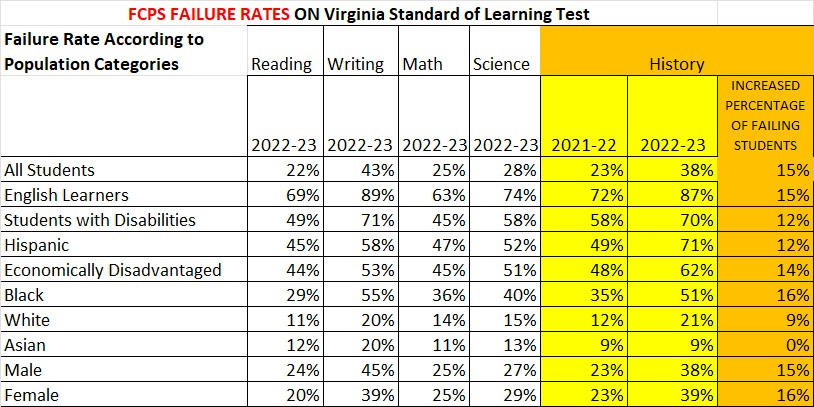
Failure rates for Fairfax County Public Schools for Standards of Learning Tests for all subjects are troubling. But what is happening in History? From 2021-22 to 2022-23, the failure rates of every group, except Asians, increased. What could possibly have happened? The Fairfax Schools Monitor has been digging into what is happening with the Social Studies Curriculum and parents are not happy.
Beware the Social Studies Curriculum! — Part I

By Mark Spooner | September 3, 2023
As a new academic year begins, Fairfax County citizens should be aware of what our children will be taught in the public schools.
Particular attention should be given to the social studies curriculum. It is not a straightforward education about history and government. It is agenda-driven, emphasizing a viewpoint supported by “progressives” and race-theory advocates. It focuses on wrongs of the past and their supposed effect on today’s society, without also stressing American ideals and the progress we’ve made. It sows division, not unity. It teaches students to look at society, past and present, from the perspective of their separate “identities” (race, gender, etc.), rather than in terms of what unites Americans. Although it is supposedly intended to teach critical thinking, it is heavily skewed towards indoctrination into a one-dimensional view of society.
Citizens of Fairfax County — Republican, Democrat and Independent — should be very concerned about the direction the curriculum has taken in the past few years under the current School Board.
Background
When the current School Board took office in early 2020, “equity” initiatives became the focus. As then-Superintendent Scott Braband said, “equity” would no longer be a thing, it would now be the thing.
Curriculum review was one of the priorities. A consultant specializing in “equity” programs (The Leadership Academy) was hired to assist. Fairfax County educators collaborated with their counterparts in five other jurisdictions to create “anti-racist, culturally responsive” courses. Numerous seminars were conducted to instruct teachers about “privilege,” “social justice” and the like.
The guiding concept of the social studies agenda was to examine events and institutions of “power, position and bias” in our history. The curricula developers also wanted to increase opportunities for students to become activists in pursuit of the program’s goals.
One seminar conducted during this process was entitled “Curriculum for Equity.” It declared that “only a transformational pedagogy, founded on racial justice, will allow us to realize our ideas of diversity and social justice.” Through such a pedagogy, “we create citizens who understand the value of these ideas — and who embody them through social justice.”
The activists who revised the social studies curricula pursued their “transformational” objectives with a vengeance.
Main Themes of the Social Studies Curricula
This article will focus on the over-arching themes of the new social studies curricula in the Fairfax County schools — U.S. History, World History and Civics. A subsequent post will discuss some of the specifics of what’s being taught.
The curriculum guide for the 11th grade U.S. History course illustrates the objectives. It is HERE.
The introduction confirms that the curriculum is based on “FCPS Design Principles for Cultural Responsiveness” and standards from the “Learning Justice Anti-Bias Framework,” using “backwards design” principles. “Backwards design” refers to a process by which academicians begin by identifying the key concepts they want students to take away from a course, and then work backwards to construct lessons that will drive those concepts home.
The curriculum guide identifies these goals:
“Students will demonstrate history and social science thinking skills and practices, with an emphasis on the concepts of power, position, bias, and agency, and apply them to their learning regarding their identities, communities, states, the nation, and the world. (Emphasis in original)
Students will develop language and historical and cultural knowledge that affirm and accurately describe their membership in multiple identity groups.
Students will examine diversity in social, cultural and political and historical contexts rather than in ways that are superficial or oversimplified.”
These concepts — “identity,” “power,” “position,” “privilege,” “bias,” and “agency” — are the “backward design” concepts that permeate almost every lesson. Fairfax County educators want students to view history and government primarily from this perspective.
“Identity”
The concept of “identity,” as used in the Fairfax County public school system, calls upon students to view themselves, and their position and opportunities in society, in terms of their race, ethnicity, gender, gender-identity and religion. For example, “I am White; therefore, I am privileged,” or “I am Black; therefore, I have fewer opportunities.” A person can be a member of more than one of these groups; this is referred to in today’s jargon as “intersectionality.” According to the progressives, intersectionality can compound the difficulties a person faces in the world; for example, “I am a Black female; therefore ….”
Calling upon students to focus on these immutable “identity” characteristics is the opposite of the “E pluribus, unum” motto of the United States. Traditionally, students have been taught, and Americans have generally believed, that although we have come here from many places around the world, we have melded into one culture, sharing common values. “From many, one.” Thus, “I am an American,” not “I am a member of three minority groups.”
For today’s “progressives,” the concept of “E pluribus, unum” is anathema. For example, Ibram X Kendi, whose views have been embraced by the Fairfax County School Board, argues that assimilation into a common culture should be opposed. He contends that “assimilationist ideas are racist ideas” and that “to be antiracist is to equate and nurture differences among racial groups.” Thus, creation of separate racial spaces on campuses should be viewed as legitimate efforts to protect a minority from racism.
Preoccupation with “identity” sows division, not unity, and yet it is one of the key concepts now embodied in the curricula of Fairfax County public schools.
“Privilege, Power and Position”
Another major focus of the Fairfax County social studies curricula is the role of “privilege,” “power” and “position” in history and government.
“Privilege” is a term used by today’s “progressives” to suggest that Whites have inherent advantages in the law and society because of their race. “Position” and “power” are used to say that some people hold positions of power and others do not. This is an unremarkable statement in itself, but in the Fairfax County school system, the idea is closely tied to the concept of “identity,” discussed above. The emphasis is on White men holding power, and exercising that power, for their own benefit, at the expense of virtually everyone else: Blacks, women, Native Americans, immigrants, etc.
All of history is viewed through this narrow lens. The theme is that those in positions of power not only act selfishly to promote their interests at the expense of others on some occasions, but also that this is a dominant theme of our history and government institutions. This idea is unrelentingly pounded home in lesson after lesson, as will be shown in the next article on this site. Along with the concept of “identity,” privilege, position and power are used to bolster the notion that some identity groups have been and remain victims of bias and “systemic injustice.”
“Critical Thinking”
The school system touts its social studies curricula as being designed to promote “critical thinking.” But this is a misleading term. As used by Fairfax County educators, it does not mean teaching students to analyze issues for themselves in an objective manner, considering all points of view, historical realities and difficult choices. Rather, it means teaching them to evaluate history from the perspective of “identity,” “power,” “privilege,” “systemic racism,” etc.
Fairfax County administrators admit as much. They say the curricula are aligned to the FCPS Principles for Cultural Responsiveness. One of these principles is to embody a “critical lens” in teaching. This means that “students are encouraged to examine materials, events, and institutions critically, attending to power, position and bias,” i.e., the narrow, biased lens chosen by the “progressive” educators.
A particularly outrageous example is in the 12th grade U.S. Government course. For the unit entitled “US Constitution & Federalism,” the “core standard” in the curriculum guide is that:
“Students will apply social science skills to understand the federal system of government described in the Constitution of the United States with an emphasis on the concepts of power, position, bias, and agency. (Emphasis in original)
Students will analyze the harmful impact of bias and injustice on the world, historically and today.
Students will recognize their own responsibility to stand up to exclusion, prejudice and injustice.”
Unbelievable! Adoption of the Constitution was the greatest achievement in governance in the history of the world up to that time. Delegates from all thirteen colonies spent an entire summer in Philadelphia considering the strengths and weaknesses of various forms of government. The delegates represented different colonies with divergent interests, and yet they compromised to create a framework for government that has endured and has led to the democratic, prosperous nation we have today … a nation sought out by people around the world. But the “critical thinkers” who developed the Civics curriculum want to portray it as a example of “power, position and bias” in action, requiring students to reflect on injustice in the world, historically and today.
What’s the point? That all the delegates were men and the Constitution didn’t guarantee a right to vote for women? This ignores the fact that society was very different in the 1780s than it is today. Or is the point that the Constitution didn’t abolish slavery, even though it wasn’t feasible to do so at that time? True critical thinking would ask students to reflect on then-existing societal standards and the hard choices our Framers had to make. It wouldn’t reflexively condemn our Constitution by uncritically applying today’s standards to the realities of 235 years ago.
Conclusion
If you sometimes wonder why Americans are more divided today than in the past, or why they are less patriotic, look to your school system for part of the answer. Our children are being indoctrinated in divisiveness and contempt for our history and institutions.
Parents with children taking social studies courses in Fairfax County public schools should exercise their right to demand access to all curriculum materials. If the teachers are teaching the concepts set forth in the curricula guides developed in the central office, parents should confront them with the fact that they are violating the Controversial Issues Policy, which requires teachers to remain neutral regarding issues like these.
Going forward, citizens should vote in November to elect School Board members who will eliminate indoctrination from the curricula.
The next post on this site will explore the subject further by taking a close look at the lessons in the 11th grade U.S. History course.
 parentsoutofexile